
42nd Mid-Continent Paleobotanical Colloquium
May 17-18, 2025
Wesleyan University, Middletown, CT
Organizing committee: Dana Royer, Xiaoqing Zhang
Friday
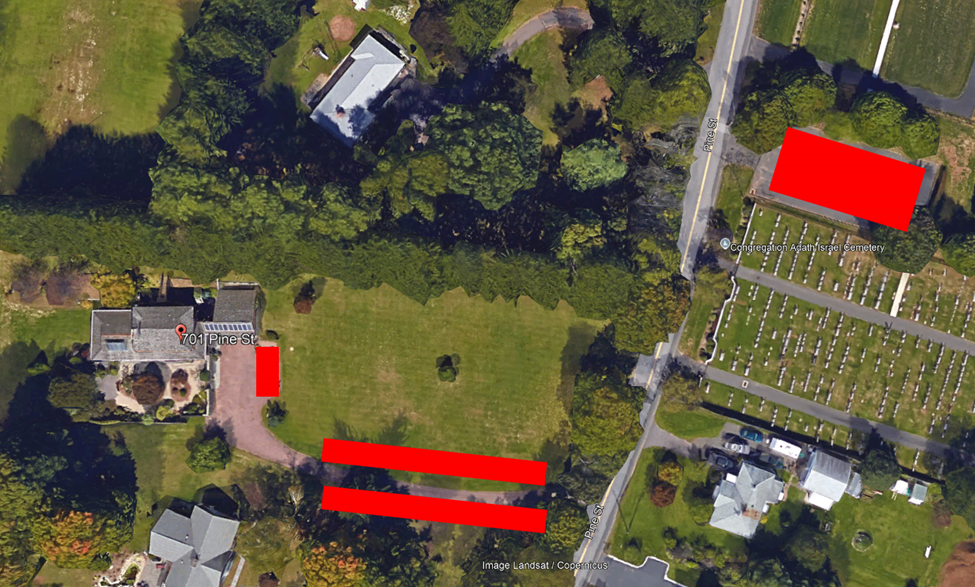
5:30-9:00 pm dinner party at Dana Royer’s house. For folks staying at the Inn, we will pick you up at 5:30 (two trips may be required). For everybody else, the address is 701 Pine Street in Middletown; we encourage carpooling. Please park at the top of the driveway, on the grass on either side of driveway along the hill, or in the cemetery parking across the street (see red areas in image below). There will be wine and beer.
Saturday
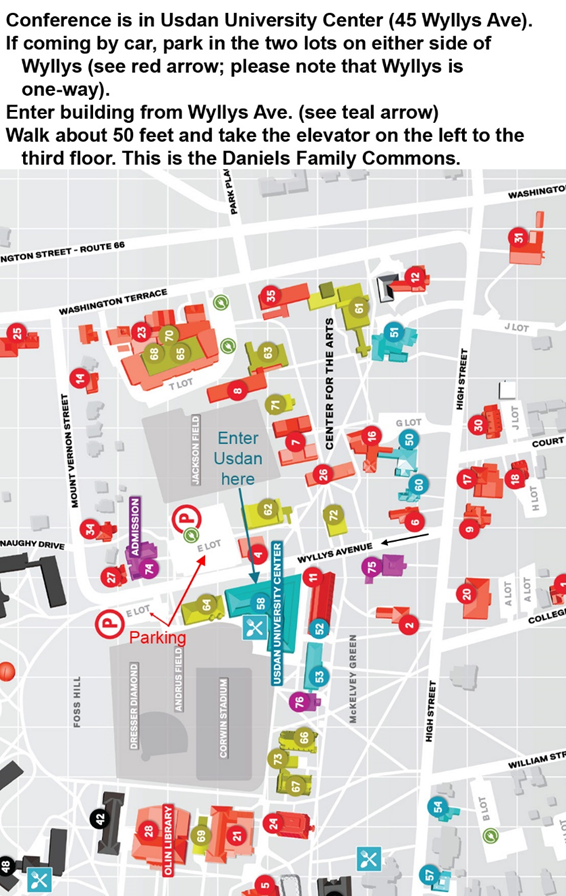
The program starts at 8:20 am, with a light breakfast starting at 7:45. Please email Xiaoqing if you would like a ride from the Inn of Middletown at 7:45 (it is otherwise a 0.6 mile walk); if it is raining we will make sure there is a shuttle available at 7:45. If driving, park opposite the Usdan University Center (see image below); we encourage carpooling. Our conference is in the Daniels Family Commons, which is the third floor of Usdan. We will be there the entire day, including lunch and dinner (no alcohol, sorry). Talks are 10 minutes in length. Poster boards are 30 x 40” (you choose between portrait and landscape orientation).
| 42nd Mid-Continent Paleobotanical Colloquium Wesleyan University, Usdan University Center, Room Saturday, May 17, 2025 | ||
| 7:45-8:20 | Light breakfast | |
| 8:20-8:30 | Welcome, Introduction | |
| 8:30-9:54 Session 1 (7 talks) | Alexander Lowe | Miocene plant communities and climate of the Pacific Northwest (USA) using a refined morphotype and geochronologic framework |
| Venanzio Munyaka | Assessing the relationship between leaf physiognomy and climate of African low-latitude floras | |
| Xiaoqing Zhang | Estimates of atmospheric CO2 during the CPE (Carnian Pluvial Event, Triassic period) based on stomatal and isotopic analyses of fossil leaves from South China | |
| Rebecca DeKoster | Arthropod herbivore and pathogen damage associated with the Middle Pennsylvanian Mazon Creek Flora, Illinois, USA | |
| Parker J. Przybylski | Insect damage on the Indo-Pakistan collision front (Ghazij Formation, Balochistan, Pakistan): First tropical insect-feeding damage for the Early Eocene Climatic Optimum | |
| MacKenzie Smith | Leaf documentation and Digital Leaf Physiognomy estimate of the Coal Creek Member of the middle Eocene Kishenehn Formation in northwestern Montana, USA | |
| Li Zhang | Tracing palaeo-gaseous mercury variations through fossil plants: Preliminary analysis of mercury concentration data in extant Ginkgo and extinct ginkgoaleans | |
| Until 10:30 | Coffee break | |
| 10:30-11:54 Session 2 (7 talks) | Walton Green | A systematic procedure for estimating supportable taxonomic resolution of fossils |
| Gussie Maccracken | A time-tested system for morphotyping large fossil floras integrated with recent advances in leaf architecture scoring and databasing | |
| Theodore Matel | Spatial resolution, compositional fidelity, and isotaphonomy of leaf assemblages | |
| Paul Strother | The co-occurrence of Zygnema and a land plant spore in latest Ordovician deposits indicates “some (genomic) assembly required” | |
| Michael D’Antonio | Structure and development of the Cormophyton rhizomorph | |
| David Winship Taylor | A permineralized cycad stem, Tianocycas yunnanensis gen. et sp. nov. (Cycadales), from the Upper Permian in eastern Yunnan, China | |
| Antonietta B Knetge | Regional plant ecological turnover and diversity loss at the end-Triassic mass extinction at the Jameson Land Basin, East Greenland | |
| Until 14:00 | Lunch and posters session | |
| 14:00-15:12 Session 3 (6 talks) | Yongdong Wang | The Jurassic Fossil Forest in the Sichuan Basin, China |
| Hector Palma | A century of paradox: Re-investigating paradoxopterid ferns with new material from the Early Cretaceous of Northwestern Gondwana | |
| Ashley Hamersma | Revision of the fossil flower genus Sahnianthus Shukla (Myrtales) from the latest Cretaceous Deccan Intertrappean Beds of India | |
| Andrew Simpson | Reevaluating the relationship between dispersal mode and survivorship in the light of the Hattiesburg Flora | |
| Whitney Greaves | A Paleobotanical Overview of the Upper Cretaceous Neslen Formation with a focus on a new species of Protodammara | |
| Christopher West | Floristic Composition and Paleoclimate of the early Paleocene Highvale Mine Ardley Coal Zone Fossil Flora, Central Alberta, Canada | |
| Until 16:00 | Coffee break and Group photo | |
| 16:00-17:00 Session 4 (5 talks) | Caroline Siegert | Not your average fruit cups: Fossil fruits and cupules with multiple development stages from the early Eocene of Argentine Patagonia |
| Julian E Correa-Narvaez | Ferns resembling Thelypteridaceae from the Eocene of western North America: One Pinnate-Pinnatifid fern on the wall, one Pinnate-Pinnatifid fern. Take one down, pass it around, … two Pinnate-Pinnatifid ferns on the wall? | |
| L. Alejandro Giraldo | Organically preserved leaves from the Eocene Anglesea flora reveal first early Paleogene records of four angiosperm families in Australia | |
| Noah Crook | Taxonomic revision of Gyrocarpus miocenica: Fossil Malpighiaceae from the Miocene of Northwestern Venezuela | |
| Tengxiang Wang | Early Pleistocene flora from central Vietnam and its links to southern Indochina’s extant tropical monsoonal forests | |
| Until 20:00 | Dinner & Keynote: Tammo Reichgelt | Vanished voyagers of Moa’s Ark: Post-Miocene homogenization of New Zealand’s vegetation |
List of Posters
| Sampling strategies and their influence on paleoecological interpretations at the Triassic–Jurassic boundary Barbosa, C.; Knetge, A.; Glasspool, I. J.; Hesselbo, S. P.; Matthaeus, W.J.; Popa, M.E.; Sunderlin, D.; McElwain, J. C. |
| Calibrating the reconstructed Leaf Area Index method for Colombian Dry Forest using Cuticle Trace Cham, M.; Cantu, C. ; Stiles, E.; Strömberg, C. |
| Plant-Insect Interactions from Oligocene Beaver Creek, South-Western Montana Gaarder, G.; Hamersma, A. |
| Investigating fossil seeds of the Paleocene of North America by means of micro-CT scanning Krinsky, K.; Manchester, S. R., Tiffney, B. H. |
| Peltate leaf from Australia’s Anglesea flora (middle Eocene, Victoria) supports an out-of-Gondwana history for the Macaranga-Mallotus clade (Euphorbiaceae) Miller, A. S.; Giraldo, L. A.; Wilf, P.; Carpenter, R. J. |
| Leaf epidermal cells record the canopy response to changing climate during the late Paleocene to early Eocene in the Bighorn Basin, WY Morgen, R. C.; Milligan, J. N.; Burke, L.; Barclay, R. S.; Dunn, R. E.; Wing, S. L. |
| Zircon U-Pb Geochronology and Paleofloristic Interpretations of the Maple Falls Member (Chuckanut Formation), Washington, USA Nares, F. R.; Yasar, I. D., Manchester, S. R. |
| A New Fossil Fruit from the early-Cretaceous Dakota Formation of Nebraska, USA Santiesteban, M.; Hamersma, A.; Manchester, S. R. |
| An investigation of tropical angiosperm genome sizes from the Albian-Cenomanian Une Formation of Colombia Smith, B. A.; Zhang, X., Shi, G.; Jaramillo, C.; Carvalho, M.; Herrera, F. |
Complete program and abstracts available here:
Sunday
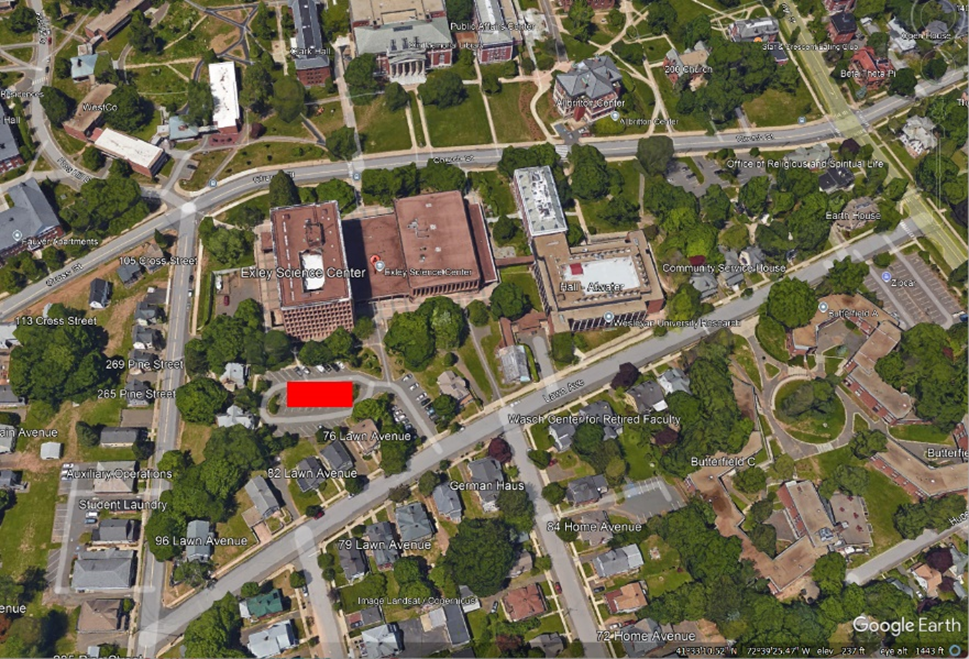
No food is provided. We will depart from the Lawn Avenue parking lot next to Exley Science Center at 10:00 (see red area in image below) and stop at the Powder Hill Dinosaur Park to view in-situ dinosaur footprints. Additionally, we will open up the Joe Webb Peoples Museum of Natural History on the 4th floor of Exley 30 minutes before departure. If you are staying at the Inn, we will shuttle you to Exley at 9:30.
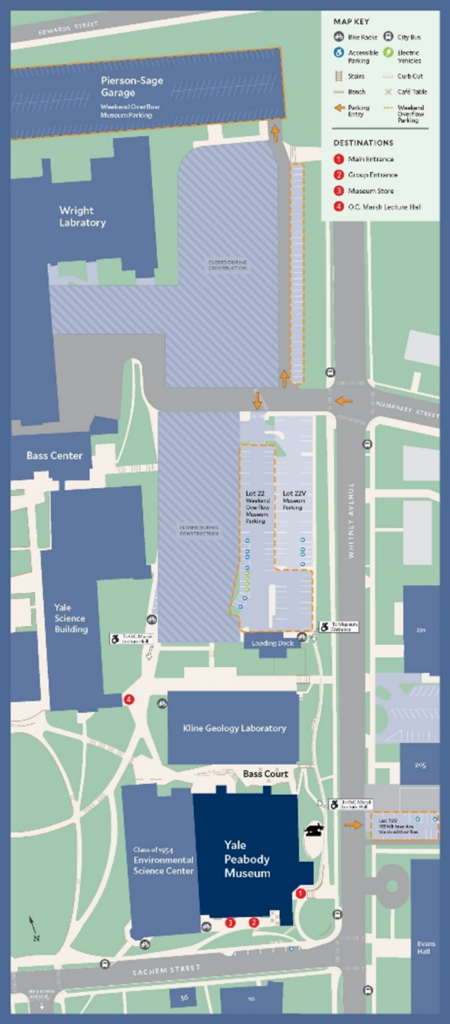
If you have your own transportation, you can join the caravan or drive directly to the Yale Peabody Museum (see also image below)—the caravan will arrive shortly after 11:00 am. We will first have a tour of the Paleobotany Collections with Dr. Shusheng Hu. The public exhibits open at noon. There is no charge to enter the museum, so you can come and go as you please. The vans back to Wesleyan will leave at 2:00 pm sharp. There are multiple lunch spots close to the museum, including Olmo Bagels (bagels and bagel sandwiches; ~5 min walk), G Café (sandwiches and salads; ~5 min walk), and Nica’s Market (wide range in sandwiches and soups; ~10 min walk).